
The Ultimate Guide to Cotton Candy and Candy Floss: Everything You Need to Know
You walk past a carnival stall, and something stops you mid-step.
It is not the music. It is not the lights. It is a smell, warm, sweet, and instantly familiar, like someone bottled a summer afternoon and left it open in the air. You follow it without thinking. And there it is. A spinning drum. A paper cone. A cloud of pink and blue sugar that looks too soft to be real.
You already know what it tastes like before you take a bite. That is the thing about cotton candy. It lives in your memory long before it reaches your mouth.
At flavorsuggest.co, we spend a lot of time thinking about how food makes people feel. And few snacks in the world create that instant emotional pull the way spun sugar does. Whether you call it cotton candy or candy floss, this airy confection has been winning hearts since the early 1900s, and it shows absolutely no signs of stopping.
Cotton Candy and Candy Floss: Is There Actually a Difference?
Here is the short answer: no. They are completely the same thing.
The name just depends on where you grew up. In the United States, people call it cotton candy. In the United Kingdom, Australia, and many other parts of the world, it goes by candy floss. Some older texts and a few nostalgic vendors still use the original name “Fairy Floss,” which is what the inventors themselves called it back in 1904.
Same sugar. Same spinning process. Same melt-in-your-mouth texture. Different names, same magical result.
If you have ever searched online trying to figure out if candy floss tastes different from cotton candy, you can stop wondering. You have been eating the same thing your whole life, just under a different label depending on which country you were in.
The Wild History of Spun Sugar (Yes, a Dentist Invented It)
This is the part that surprises almost everyone.
The Dentist Who Started It All
Cotton candy was not invented by a candy maker or a sugar company. It was co-created by a dentist. In 1897, William Morrison, a dentist from Nashville, Tennessee, teamed up with a confectioner named John C. Wharton. Together they built the first electric machine that could melt sugar and spin it through tiny holes using centrifugal force.
Think about that for a moment. A man whose career depended on fixing teeth helped invent one of the most tooth coating treats in history.
The 1904 World’s Fair Debut
Their machine was ready by 1904, and they brought it to the St. Louis World’s Fair under the name “Fairy Floss.” People went absolutely wild for it. Morrison and Wharton sold tens of thousands of boxes at 25 cents each, which was not cheap at the time. The crowd did not care. They had never tasted anything like it.
The product was light. It was sweet. It dissolved instantly. And it felt like eating a cloud.
How Cotton Candy and Candy Floss Got Its Name
A couple of decades later, in the 1920s, another dentist named Josef Lascaux tried to improve the machine design and filed a patent for it. He used the term “cotton candy” in his application. That name caught on across North America, and the rest is history.
Today the global spun sugar market is still growing. Food industry data from 2024 confirms that North America remains the largest market for this treat, but consumption is rising across multiple regions. What started as a novelty at a World’s Fair is now a multi-million dollar snack category sold at amusement parks, sports arenas, grocery stores, specialty food shops, and online.
How Is Cotton Candy and Candy Floss Actually Made?
You have probably watched someone make it fresh and found yourself completely hypnotized.
The Spinning Process
The process is surprisingly simple once you understand it. A machine heats regular granulated sugar until it becomes liquid. That liquid sugar is then pushed through a spinning head full of microscopic holes. As it flies through those tiny openings at high speed, centrifugal force stretches the sugar into incredibly thin threads. Those threads cool the moment they hit the air and pile up into the fluffy, cloud-like structure you recognize.
Why It Feels Like Nothing
The reason it feels so light is that the final product is almost entirely air. The actual amount of sugar inside a full paper cone is much smaller than it looks. Most of what you are holding is empty space.
Why It Melts So Fast
And the reason it melts so fast? It comes down to the surface area to volume ratio of each thread. Because the sugar is spun into strands so incredibly thin, there is an enormous amount of exposed surface relative to almost zero mass. The moment those threads touch moisture, whether from your tongue or from the air, they dissolve back into liquid sugar almost instantly. This is called hygroscopic dissolution, and it is why you should never leave your cotton candy sitting in a humid room or near an open drink.
If you have ever tried to store spun sugar and found it collapsed into a hard sticky lump, now you know exactly why. Moisture is its one real weakness.
Why is Cotton Candy and Candy Floss Always Pink and Blue?
Close your eyes and picture cotton candy. If you are like most people, you immediately see pink and blue.
That is not a coincidence. It is decades of conditioning and it started for a very practical reason.
When early carnival vendors were selling spun sugar at fairs and outdoor events, they needed their product to be visible from across a crowded field. Bright colors solved that problem. Pink and blue together created strong visual contrast that caught the eye from a distance. People would see those fluffy clouds and follow them like a compass.

Over time, those two colors became locked to specific flavors. Pink cotton candy almost always carries a vanilla or strawberry flavor profile. Blue cotton candy is almost universally blue raspberry. The color-to-flavor association is now so deeply ingrained that most people expect it without even thinking about it.
You pick up a pink puff and your brain already anticipates sweet strawberry. You reach for the blue, and your mouth gets ready for that sharp, fruity blue raspberry burst. The visual cue creates the flavor expectation before a single crystal of sugar touches your tongue.
That is remarkably powerful for a snack that has existed for over a hundred years. And it is a big part of why pink and blue cotton candy remain the industry standard no matter how many new flavors enter the market.
What Does Cotton Candy and Candy Floss Actually Taste Like?
People describe it as pure sweetness, and that is true, but there is more to it than just sugar.
The Flavor Depth You Did Not Expect
The flavor of classic spun sugar has a warm, toasted quality to it. Some people call it burnt caramel. Others say it is closer to toasted vanilla. That subtle depth comes from the heating process. When sugar gets hot enough to liquefy and then gets rapidly spun and cooled, it goes through a brief phase change that gives it a faint roasted note you do not get from plain sugar straight out of the bag.
Pink vs Blue: Which Wins?
The pink version, usually vanilla or strawberry, is softer and sweeter. The blue version, blue raspberry, is slightly brighter and sharper. If you eat both together, which most people do, you get a layered sweetness that is more complex than either one alone.
Why the Texture Changes Everything
The texture plays a huge role in how the flavor lands. Because it melts before you can chew it, the sweetness spreads across your entire palate at once rather than building gradually. That sudden, full-mouth hit of sweetness is a big part of why people find it so satisfying even though it is gone in seconds.
The Best Cotton Candy Products You Can Buy Right Now
You do not need to wait for a carnival to enjoy this flavor. The market has expanded significantly, and some of the products out there are genuinely impressive.
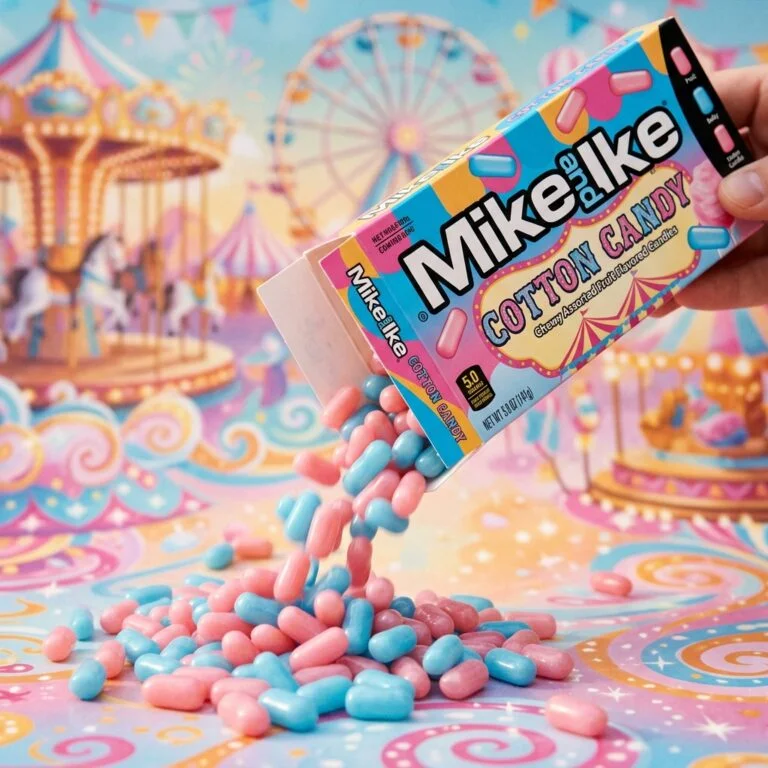
Cotton Candy Mike and Ike
If you love a chewy candy that actually delivers on its flavor promise, Mike and Ikes cotton candy deserves a place in your snack rotation. These oblong chewy candies capture the vanilla-forward, slightly toasted sweetness of real spun sugar in a format you can eat without sticky fingers. The flavor is accurate in a way that a lot of cotton candy-flavored products simply are not. You get the fairground taste without the mess.
Classic Tubs of Pink and Blue Spun Sugar
Sometimes you just want the real thing. Pre-made tubs of pink and blue cotton candy are widely available and work better than you might expect. The best versions are sealed tight to keep moisture out, which preserves the airy cloud-like texture for weeks. They make great movie night snacks, party favors, or gifts for kids and adults alike.
Floss Sugar for Home Cotton Candy Machines
Home cotton candy machines have gotten genuinely good. If you own one or are thinking about buying one the sugar you use matters enormously. Standard granulated sugar does not spin as cleanly as floss sugar specifically designed for machines. The specialized packs come in multiple flavors, including blue raspberry, strawberry, grape, and watermelon, and the results are noticeably fluffier and more vibrant in color.
Creative Ways to Eat Cotton Candy (Beyond the Cone)
Eating it straight off the paper cone is the classic move. But if you want to take it further, there are some genuinely fun ways to bring spun sugar into other snacks and drinks.
Popcorn and Cotton Candy Together
This one sounds strange until you try it. The salty, buttery crunch of popcorn and the instantly melting sweetness of spun sugar create a contrast that works surprisingly well. Toss them together in a bowl, and you get a sweet-and-salty movie night snack that keeps you reaching back in. The key is eating them together in the same bite rather than separately.
Drop It Into a Sparkling Drink
Clear soda, sparkling water, or lemonade all work for this. Drop a pinch of spun sugar on top of a fizzy drink and watch it dissolve in real time. It creates a bubbling, colorful reaction that looks spectacular if you are filming it and it naturally sweetens and flavors the drink as it dissolves. This trick is popular at events and parties, and it is genuinely easy to pull off.
Use It as a Dessert Garnish
A small puff of pink or blue spun sugar placed on top of a cupcake, ice cream, or milkshake instantly transforms the presentation. It adds visual drama, a burst of color, and a texture contrast that makes simple desserts feel special. Just add it right before serving remember, moisture will dissolve it fast.
The Raccoon and the Cotton Candy: The Internet’s Favorite Spun Sugar Moment
If you have spent any time on the internet, you have probably seen this video.
A raccoon finds a piece of cotton candy and does what raccoons often do tries to wash it in water before eating it. The moment the spun sugar hits the puddle, it vanishes completely. The raccoon is left holding nothing, looking genuinely baffled.
The clip became a viral sensation because it was both hilarious and strangely relatable. But it also perfectly demonstrated exactly how cotton candy behaves when it contacts moisture. There is no gradual melting. It is instantaneous. One dip and it is gone.
It is also a practical reminder: keep your spun sugar away from water, condensation, and humidity until you are ready to eat it. Once moisture gets in, there is no saving it.
How to Store Cotton Candy the Right Way
Most people store spun sugar wrong and then wonder why it turned into a shrunken, hardened clump overnight.
The rules are simple. Store it in an airtight container at room temperature. Do not put it in the refrigerator the moisture inside a fridge will destroy it faster than leaving it on the counter. Do not leave it open in a humid room or near a stove. Even the steam from a boiling pot of water across the kitchen can start to shrink it.
If you buy it in a sealed tub, keep the lid on tight between servings. If you make it fresh at home, eat it the same day for the best texture. Pre-packaged bags and tubs with proper seals can stay fresh for several weeks if you treat them right.
The goal is simple: keep it dry, keep it sealed, and keep it away from anything that produces moisture.
Frequently Asked Questions About Cotton Candy and Candy Floss
What is cotton candy made of? It is made from plain sugar heated until liquid, then spun through tiny holes to form ultra-thin threads. Food coloring and artificial flavoring are usually added to create the signature pink and blue varieties. That is the entire ingredient list.
Why does cotton candy melt so fast in your mouth? The sugar is spun so thin that each thread has almost no structural mass. The moment it contacts moisture from your saliva, it dissolves back into liquid sugar. There is nothing left to chew because it is already gone.
Is candy floss the same as cotton candy? Yes, completely. The name changes depending on where you live. The United States uses cotton candy. The United Kingdom and much of the world use candy floss. The product, the process, and the taste are identical.
Who actually invented it? Dentist William Morrison and confectioner John C. Wharton built the first machine in 1897 and debuted their creation at the 1904 St. Louis World’s Fair. Later, dentist Josef Lascaux helped develop and patent the term “cotton candy” in the 1920s.
How many calories are in cotton candy? A standard one-ounce serving on a paper cone contains roughly 100 to 110 calories. Because the product is mostly air, the actual sugar content is lower than the fluffy volume suggests.
Does Mike and Ike cotton candy actually taste like the real thing? Yes, more accurately than most cotton candy-flavored products. The vanilla-forward, lightly toasted sweetness of spun sugar comes through clearly in the chewy format. The texture is different, but the flavor is a strong match.
Can you make cotton candy without a machine? You can create a rough version of spun sugar using melted sugar and a fork off a stovetop. The result is more like a fragile sugar nest than actual fluffy spun sugar. It works as a garnish but does not compare to what a proper machine produces.
Why does cotton candy dissolve in water instantly? This is the same hygroscopic behavior that makes it melt in your mouth. Water breaks down the thin sugar structure immediately, which is exactly what happened in the famous raccoon and cotton candy video. The raccoon tried to wash it and it disappeared on contact.
What is the best flavor of cotton candy? Classic pink (strawberry or vanilla) and blue (blue raspberry) remain the most popular by a significant margin. They became the industry standard for good reason the flavor contrast between the two is balanced and satisfying. Beyond the classics, grape and watermelon are strong alternatives if you want something different.
How long does cotton candy last once opened? In a sealed airtight container away from humidity, it can last several weeks. Once exposed to open air in a humid environment, texture can start degrading within hours. Always seal it immediately after use.
Why Cotton Candy is More Than Just a Snack
Here is what makes this treat genuinely interesting from a food culture perspective.
120 Years and Still Going
It has survived over 120 years of snack industry evolution. Entire candy categories have come and gone in that time. New flavors, new textures, new formats and the market never stops changing. And yet pink and blue clouds of spun sugar show up at every fair, every stadium, every carnival, and every specialty food aisle without fail.
The Emotional Pull Nobody Can Engineer
Part of that is because the nostalgic food association it carries is almost impossible to manufacture. You cannot engineer that kind of emotional connection from scratch. It builds over generations, one childhood memory at a time.
A Sensory Experience Nothing Else Replicates
Part of it is also purely sensory. No other snack melts the way cotton candy does. No other treat disappears the moment it touches your tongue and leaves that warm sweetness behind. The dissolution kinetics of spun sugar are genuinely unique in the confectionery world.
And part of it is the sheer spectacle. Watching sugar transform into a cloud of threads in real time whether at a carnival, a street market, or in your own kitchen never gets old. It looks like a magic trick every single time.
Whether you are tearing into a tub of classic pink and blue, reaching for a bag of cotton candy Mike and Ikes, mixing popcorn and cotton candy in a bowl, or dropping a pinch into a sparkling drink, you are participating in one of the most enduring snack traditions in modern food history.
That is worth savoring. Even if it only lasts a few seconds on your tongue.
For more candy flavor guides, product rankings, and honest taste reviews, visit https://flavorsuggest.co/best-cotton-candy-flavors/ and keep exploring.