Calories in a Medium French Fry From McDonald’s: Nutrition Facts, Ingredients and What It All Means
You reach into that warm bag before you even park the car. The smell hits first. Hot oil. Salt. Something almost meaty. You already know what is inside. But do you know exactly what you are eating?
This is the complete breakdown of Calories in a Medium French Fry From McDonald’s. Every macro, every ingredient, every piece of food science behind the flavor you cannot stop chasing. McDonald’s French Fries are one of the most ordered menu items in the world and most people eating them have no idea what is actually inside.
How Many Calories Are in McDonald’s Medium French Fries?
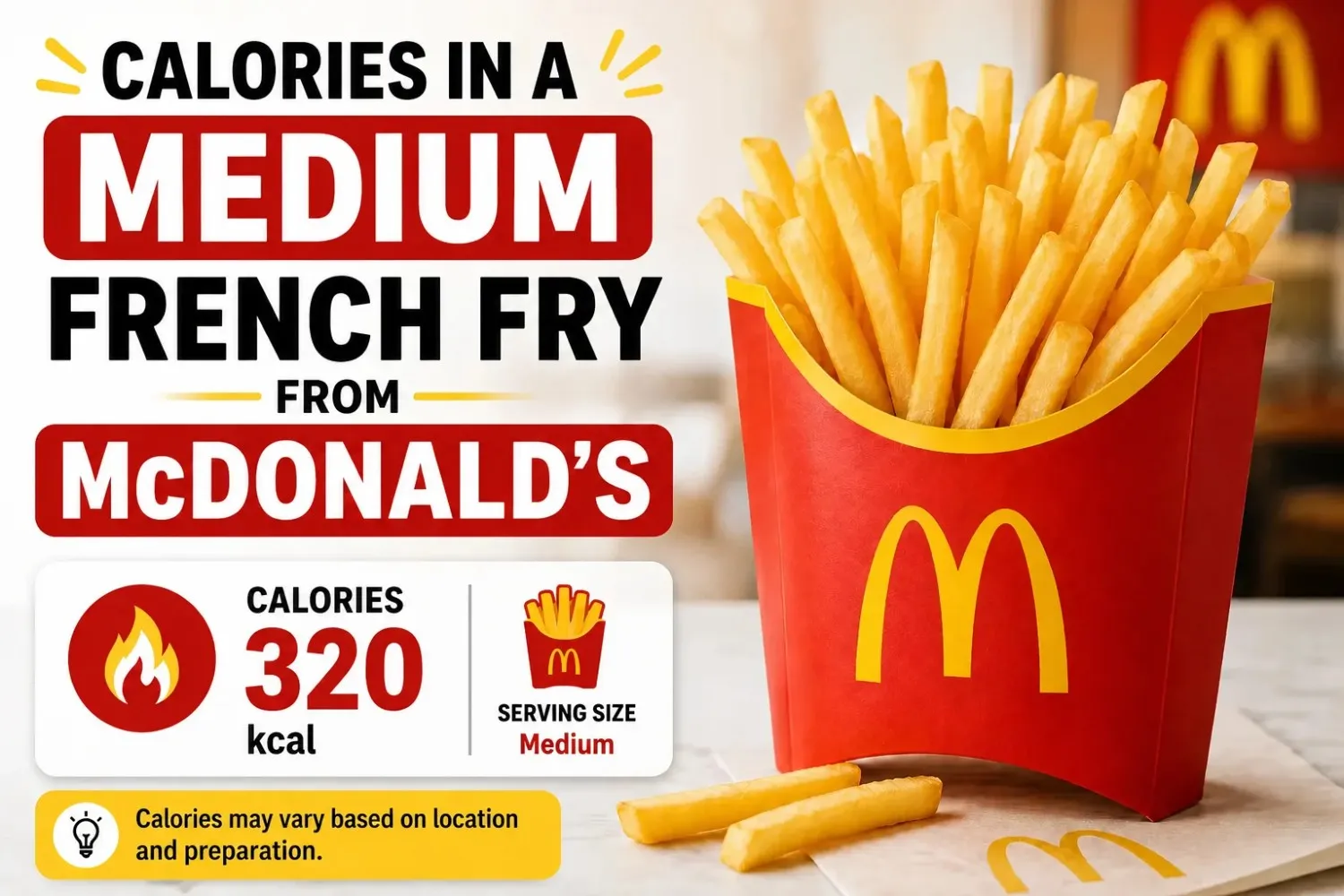
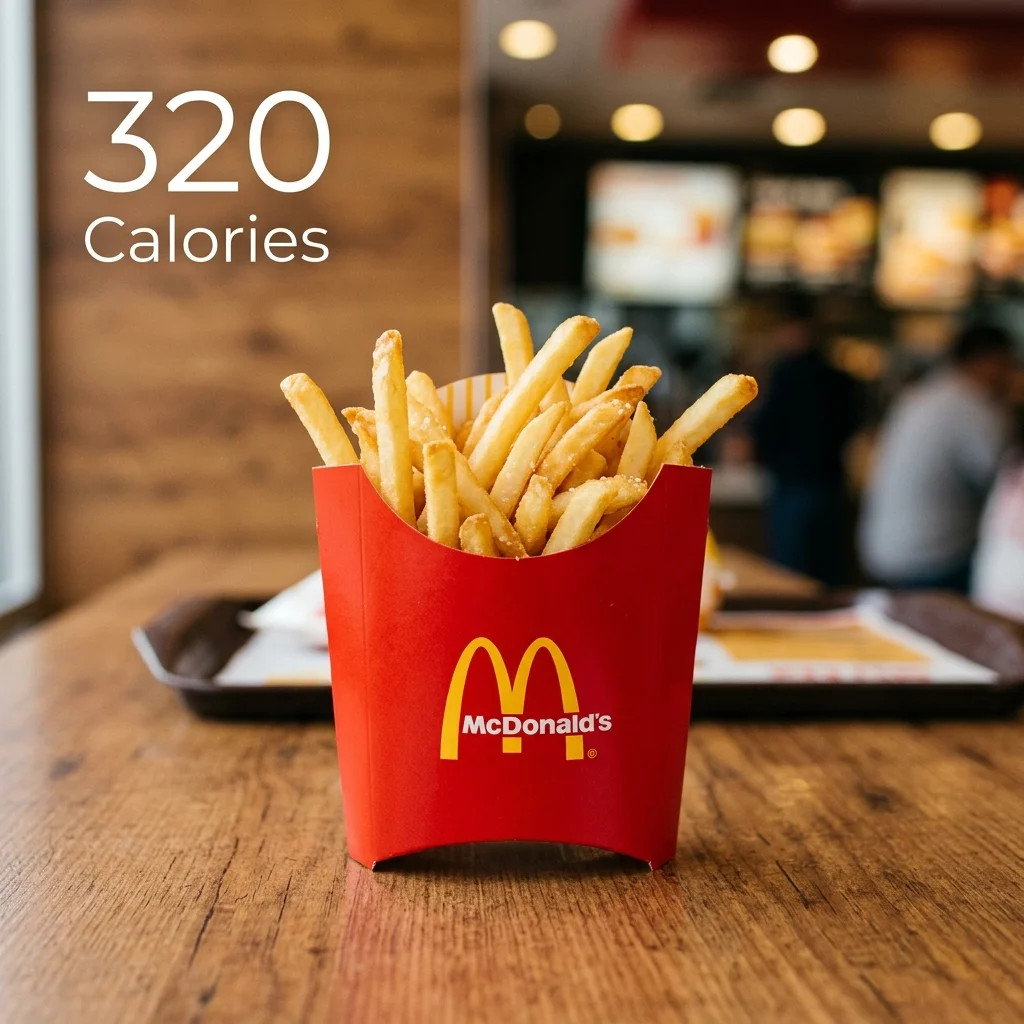
A medium serving weighs 117 grams. It contains 320 calories.
That is the fast answer. Here is the full macronutrient breakdown, including McDonald’s fries, protein, carbs, fat and sodium.
| Nutrient | Medium (117g) | Large (150g) | Small (71g) |
|---|---|---|---|
| Calories | 320 | 480 | 230 |
| Total fat | 15g | 22g | 11g |
| Saturated fat | 2g | 3g | 1.5g |
| Carbohydrates | 43g | 65g | 29g |
| Dietary fiber | 4g | 6g | 2g |
| Protein | 5g | 7g | 3g |
| Sodium | 260mg | 400mg | 160mg |
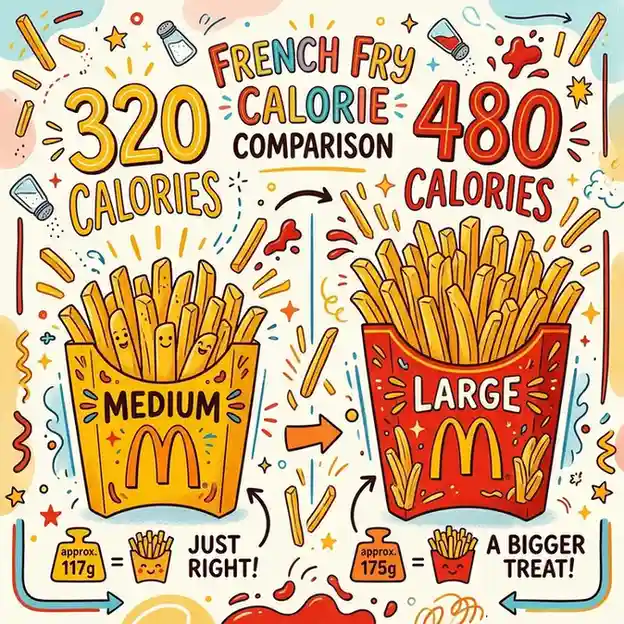
This fries calorie comparison table covers every serving size McDonald’s sells. Calorie labeling interpretation is simpler when all three sizes sit side by side. McDonald’s medium fries calories come to 320 per serving. McDonald’s large fries’ calories reach 480. The calorie density climbs as the serving grows:
- More oil is absorbed per gram at larger quantities.
- The medium accounts for 16 percent of a standard 2,000 calorie daily dietary energy intake. The large climbs to 24 percent.
McDonald’s Fries Calories 2026: Are the Numbers Current?
Yes. Calories in McDonald’s fries reflect current McDonald’s fries nutrition facts. USA figures verified against USDA FoodData Central. How many calories in McDonald’s fries? 230 for small, 320 for medium, 480 for large. Calories in medium McDonald’s french fries have not changed with the 2026 formulation. McDonald’s has not altered the core recipe recently, so the numbers you see posted in the restaurant match what is on the app.
Medium vs. Large Fries Calories: Is Upsizing Worth It?
The medium gives you 2.7 calories per gram. The large gives you 3.2 calories per gram.
Calories in McDonald’s large french fries vs medium show a 160 calorie jump and a 140 mg sodium increase. In a pure portion size scaling analysis, you are getting proportionally more fat and sodium than extra potato when you upsize. The energy intake comparison does not favor the large for anyone watching their daily budget.
For practical portion control, the medium is the smarter call most days. Among fast food fries calories across chains, McDonald’s medium sits in the middle of the range, below Five Guys but below Chick-fil-A on sodium.
McDonald’s Fries Ingredients Breakdown: What Is Actually in There?
Most people think it is just potatoes and oil. The full McDonald’s fries ingredients list tells a different story.
The Potato
McDonald’s uses the Russet Burbank potato and the Shepody potato. Both are chosen specifically for high starch content. That starch content is what creates the fluffy, steamy interior after frying. Starch transformation during cooking is the reason the inside feels almost like soft mashed potato while the outside stays crisp.
The Oil Blend
The frying oil is a blend of canola oil, corn oil, soybean oil and hydrogenated soybean oil. Understanding the McDonald’s fries oil blend composition matters for two reasons.
First, the oil emulsification system affects texture. Hydrogenated soybean oil raises the smoke point and stabilizes the blend through repeated frying cycles. Second, lipid oxidation during high-heat frying is part of what generates the signature aroma compounds that hit you when the bag opens.
Natural Beef Flavor
This is the ingredient most people miss. Natural beef flavor is added to the oil. It is produced using hydrolyzed wheat proteins and milk derivatives. This is part of the food manufacturing chain that replaced original beef tallow decades ago while preserving the savory depth of the original flavor.
It also means McDonald’s fries in the United States are not vegan and not gluten-free. Allergen exposure is real here. People with celiac disease also face a cross-contamination risk at the fryer. In the UK, the formulation differs and the fries are considered vegan-friendly, so always check local McDonald’s fries nutrition facts for your region.
Dextrose
Dextrose is added before par-cooking. It promotes even browning through the Maillard reaction. Without it, color development across the surface would be uneven.
Sodium Acid Pyrophosphate
Applied after cutting, this compound prevents raw potato from oxidizing and turning gray before frying. It has no effect on flavor or on the McDonald’s fries nutritional breakdown.
Salt
Applied after frying, not before. The timing creates direct contact between salt crystals and the crispy outer surface. The sensory experience of fries starts the moment that salt hits your tongue.
Are McDonald’s Fries Vegan or Gluten-Free?
Not vegan in the US. The natural beef flavor contains milk derivatives. Are McDonald’s fries vegan or gluten free? The answer is no to both in the United States.
Not gluten-free in the US. Hydrolyzed wheat is used in producing the natural beef flavor. Allergen exposure from this ingredient is a genuine concern, not a minor footnote.
Outside the US, formulations vary. Check the local source before assuming.
McDonald’s Fries, Protein, Carbs and Fat: What Each Does
The macronutrient composition of a medium fry works like this:
43g of carbohydrates provide fast energy. The potato is mostly starch that converts quickly to glucose.
15g of fat slows digestion. It is also what makes you feel full longer after eating. The saturated fat sits at 2g, well within a single meal’s reasonable range.
5g of protein is modest but present. Potato naturally contains small amounts of protein and the frying process preserves most of it.
Sodium in McDonald’s fries is the figure worth tracking most closely. At 260mg per medium serving, you are consuming 11 percent of the FDA daily limit in one side dish. A large increase that to 17 percent.
Are McDonald’s Fries Healthy?
The Harvard T.H. Chan School of Public Health has linked frequent fried potato consumption to metabolic risk factors over time. That is a real finding from nutritional epidemiology research worth knowing. The health effects of fried potatoes become more significant as frequency increases, not from a single serving.
Processed food evaluation should account for dietary guideline frameworks, not just one meal. A medium fry as an occasional side within a varied diet is not a problem. A daily large fry alongside other high-sodium, high-fat items is a different pattern.
The food composition databases, including USDA FoodData Central, classify this as a high-sodium, moderate-fat processed food. Knowing that helps you make a genuinely informed choice rather than an accidental one.
How Long Does It Take to Burn Off McDonald’s Fries?
Calorie burn equivalence depends on body weight and metabolic rate. These numbers use energy expenditure modeling based on USDA data for a 150-pound adult. How long to burn calories from McDonald’s fries? Here is the McDonald’s fries calorie breakdown by activity.
| Activity | Medium (320 cal) | Large (480 cal) |
|---|---|---|
| Walking (moderate) | 85 minutes | 128 minutes |
| Swimming (laps) | 30 minutes | 45 minutes |
| Cycling (steady) | 45 minutes | 68 minutes |
How many calories do I burn walking? Roughly 3.5 to 4 calories per minute at a moderate pace for that body weight. Heavier individuals burn more per minute, so actual burn time may be less.
Metabolic compensation matters here too. Your body adjusts after exercise, so these numbers represent a useful frame, not a precise transaction.
Why Do McDonald’s Fries Taste So Good? The Food Science Answer
This is not an accident. Every element of the flavor and texture is the result of deliberate food engineering.
Dynamic Texture Contrast
The outside is rigid and brittle. The inside is soft and steamy. Dynamic texture contrast is the food science term for this combination. Your brain processes both signals at once and finds the pairing deeply satisfying. It is one of the primary reasons why McDonald’s fries are so addictive from a sensory neuroscience standpoint.
The Double-Frying Technique
The potatoes are par-fried and flash-frozen before reaching any restaurant. At the restaurant, they are fried a second time. This double-frying technique is what creates the rigid crust while keeping the interior undamaged. The Maillard reaction fires during both cycles, producing the golden color and toasted flavor compounds.
Umami Flavor Perception
Natural beef flavoring adds umami to every fry. Umami is the fifth basic taste. It deepens and rounds out flavor in a way that makes a simple potato feel rich and complex. This is what makes the sensory experience of fries so different from homemade.
Aroma-Driven Appetite Response
Smell is a major part of taste perception. The aroma-driven appetite response begins before the first bite. Hot oil, toasted carbohydrates and salt vapors leave the bag and prime your appetite as part of the drive-thru consumption experience. The sensory anticipation loop is running before you even see the fries.
This is a built-in part of impulse eating behavior at the drive-thru. Knowing it does not reduce the pleasure. It explains why the pleasure arrives so fast.
Why They Taste Worse Cold
Starch retrogradation is the culprit. As fries cool, starch molecules recrystallize into a denser structure. The fluffy interior turns gummy. The surface fat solidifies. Dynamic texture contrast collapses. That is the science behind every disappointing cold fry.
McDonald’s Fries Calorie Tracking: What to Log
For anyone using fries calorie tracking tools or apps, here is the exact data for a medium;
- Calories: 320
- Fat: 15g
- Carbs: 43g
- Protein: 5g
- Sodium: 260mg
- Fiber: 4g
The USDA FoodData Central food composition database is the most reliable reference source for McDonald’s fries nutrition facts USA. McDonald’s official nutrition page is the other primary source. Cross-check both when precision matters. You can also check our fast food guide on www.flavorsuggest.co.
Can You Order McDonald’s Fries Without Salt?
Yes. Request no salt and the kitchen cooks a fresh batch before applying salt to the rest. You get fresher fries and avoid the 260mg sodium figure from added salt. The natural sodium already present in the potato and flavoring stays, but the total drops.
It is the most underused ordering option in the drive-thru.
Frequently Asked Questions
How many calories are in McDonald’s medium french fries? A medium serving (117g) contains 320 calories. The macronutrient breakdown is 15g fat, 43g carbs and 5g protein.
How many calories are in McDonald’s large fries? A large serving (150g) contains 480 calories, 22g fat and 400mg sodium.
How many calories are in McDonald’s small fries? A small serving (71g) contains 230 calories.
Are McDonald’s fries vegan or gluten-free? No to both in the United States. Natural beef flavor contains milk derivatives (not vegan) and hydrolyzed wheat (not gluten-free).
What is in McDonald’s fries oil? A blend of canola oil, corn oil, soybean oil and hydrogenated soybean oil, plus natural beef flavor added separately.
How much sodium is in a medium McDonald’s fry? 260mg, which is 11 percent of the FDA daily recommended limit.
What potatoes does McDonald’s use? The Russet Burbank potato and the Shepody potato, chosen for high starch content.
Do McDonald’s fries contain dairy? Yes. The natural beef flavoring contains milk derivatives.
Why are McDonald’s fries so addictive? The double-frying technique, dynamic texture contrast, umami flavor from beef flavoring and aroma-driven appetite response all combine into a sensory experience that is very hard to stop eating.
What makes McDonald’s fries crispy and flavorful? The double-frying process creates the crust. The Maillard reaction creates the color and toasted flavor. Natural beef flavoring adds umami depth. Salt timing delivers immediate flavor on contact.
The Bottom Line
Calories in a Medium French Fry From McDonald’s come to 320 per serving. Behind that number sits a deliberately engineered product:
- Two specific potato varieties, a four-oil blend, natural beef flavoring, dextrose, sodium acid pyrophosphate and precise salt timing.
The macronutrient composition, the sodium intake numbers and the food science behind dynamic texture contrast and umami flavor perception are all worth knowing. You do not to feel bad about enjoying them. It is necessary to understand what you are actually eating.
That is what makes the next order a real choice rather than just a habit.